How to decide if you need a backup generator?
If you operate a comms room or data centre, you already know you need some form of backup power protection. But how do you decide exactly how long you need your data centre backed up for and what the best approach to achieving this is?
For many users, it is difficult to decide how much runtime is appropriate or necessary and balancing the benefits with the cost of providing long run times can be challenging. So how do you choose? What approach to long backup times is the most cost effective?
Uninterruptible power supplies provide a seamless link between mains power and backup battery, when the mains fails the UPS instantly provides power with no loss or downtime to the connected load.
A backup generator is an emergency power source and when the power fails the automatic transfer switch will signal the generator to start up, but there will be a loss of power for around 20-30 seconds while this happens.
So how do you decide which option is right for you?
First of all it is important to assess the risks of extended power failures to your business. A hospital for example, is likely to need a site wide solution that keeps everything powered for many hours or possibly several days, where as a small business may be quite happy to keep just the telephone system running for a few hours.
It’s also important to factor in non IT loads like cooling and lighting, because lets face it, there is no point having all of your IT equipment backed up for hours if the room overheats in 10 minutes or your staff have to go home because they can’t see what they’re doing.
Once you have established what the critical load is, you can then begin to evaluate what the appropriate amount of back run time is. To do this you have to understand the cost of downtime to the business. A retail store for example might loose £1000.00 per hour, for every hour of downtime (fig 1a), where as a production line may lose most of the money after the first 500 milliseconds of downtime (fig 1b) and other business may experience little loss for a short outage, but as the duration lengthens, there is an increased likelihood that larger losses may be incurred (fig 1c).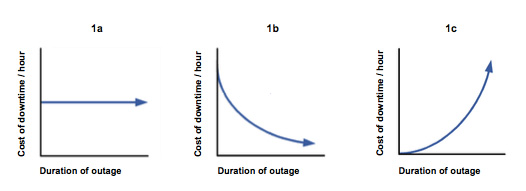 To calculate the cost properly you have to also factor in the cost of the time involved to recover from downtime. If a 500 millisecond outage is enough to halt production of a manufacturing line, but it takes 4 hours to re-start production when the power has returned, the cost continues to be incurred for far longer than just the duration of the power outage.
As well as calculating the load and the cost of downtime, and before you decide whether to go with a long run time battery solution or a backup generator, you also have to evaluate the suitability of the site and environment. Backup generators are usually installed externally, in a compound which will often be situated in the car park or on the roof of the building. Environmental restrictions, a lack of space or the landlord may prohibit the use of a generator, so on many cases batteries may be the only practical option.
For low loads, supplemental UPS batteries are easier and less expensive to install and usually a more cost effective option when it comes to providing long run times. But as the load increases and the cost of adding batteries to achieve the desired runtime starts to add up, a backup generator begins to have a economic advantage.
The truth is a comprehensive long back up time power protection solution is likely to include a UPS system and a backup generator. The shortest of interruptions will usually cause severe consequences for most organisations, so an uninterruptible power supply is an essential element of any power protection policy. When extended run time is determined to be necessary, all of the factors we have discussed need to be considered. Once the size of load and desired runtime have been established only then can you weigh up whether the site and environment allow for a backup generator or whether supplemental batteries are the better option.
Unfortunately there is no right or wrong answer to this question and no solution that fits every application. So, if your business or organisation has a need for a long run time back up power system contact a member of our team today and we will happily help you through the process.
Call: 01252 692559 or email: info@sourceups.co.uk
I contacted Source UPS when our UPS failed and straight away got helpful information. They quickly identified our problem, organised an engineer, who was on time, very pleasant and helpful. The whole experience was professional and well organised. I would highly recommend this company.