Emergency Lighting and Fire Safety Compliance in Data Centres: Which British Standards Matter?
Data centres depend on resilient power infrastructure to keep critical systems running, but continuity of IT equipment is only part of the picture. Emergency lighting and fire safety systems also require reliable backup power so that people can evacuate safely and essential life-safety equipment remains operational during a power failure.
For data centres in the UK, several standards may be relevant, including BS EN 50171, BS 5266-1, BS EN 1838, BS 9999 and BS EN 12101-10. The exact requirements will depend on the building, its fire strategy and the equipment being protected.
At Source UPS, we provide power protection and data centre infrastructure solutions, helping organisations design resilient systems for both operational continuity and critical safety applications.
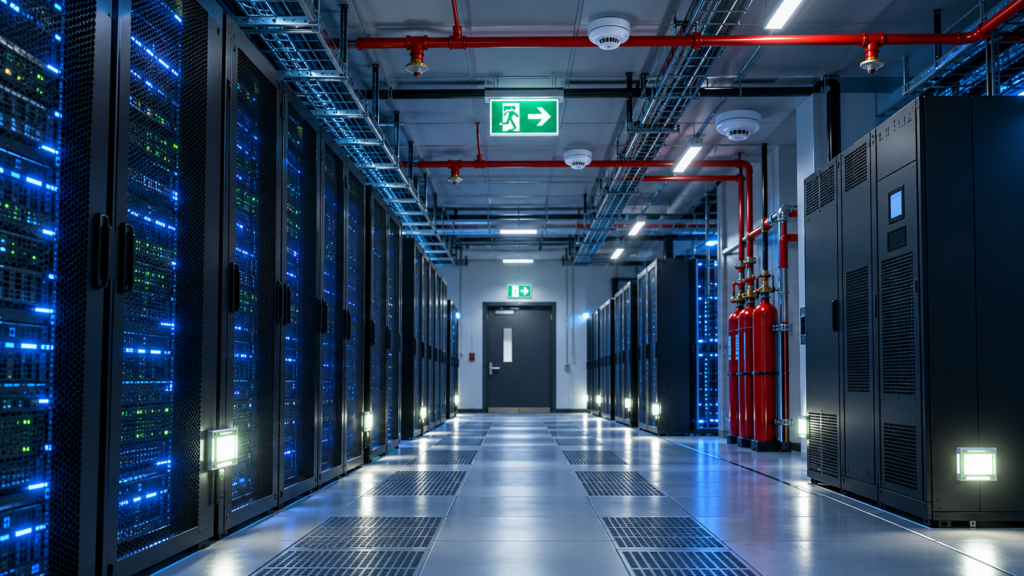
Which emergency lighting standard matters most for data centres?
For central power supply systems supporting emergency and safety equipment, BS EN 50171 is one of the key standards.
BS EN 50171 covers the design, construction and performance of central power supply systems, often referred to as CPS systems. These systems can provide backup power for emergency lighting and other safety services when the normal mains electricity supply fails.
For data centres, this is particularly important because a standard UPS intended to support servers or networking equipment may not necessarily meet the requirements of a life-safety application.
A BS EN 50171 compliant UPS must be designed with considerations such as battery life, required autonomy, recharge performance and inverter capacity in mind.
This means specifying an emergency lighting power supply involves more than simply calculating the connected load. The system also needs to deliver the required performance throughout its service life.
How do BS 5266-1 and BS EN 1838 apply?
BS 5266-1 provides guidance on emergency lighting within premises, while BS EN 1838 covers the lighting requirements associated with emergency escape and standby lighting.
Together, these standards help ensure people can safely navigate escape routes if normal lighting fails.
Within a data centre, emergency lighting requirements may extend beyond reception areas and offices. Depending on the facility, consideration may also need to be given to server rooms, technical spaces, corridors, plant rooms, access routes and other areas forming part of the building’s emergency escape strategy.
Where a central power system is used to support the emergency lighting installation, its design must be considered alongside the requirements applying to the lighting itself.
Fire safety systems need resilient power too
Fire safety in a data centre involves more than emergency lighting.
Depending on the facility, life-safety infrastructure can include fire detection systems, suppression equipment, smoke control, emergency access systems and evacuation-related equipment.
These systems need dependable power when normal operating conditions have already been disrupted. A mains failure occurring alongside another emergency should not leave critical safety equipment unavailable.
This is why emergency power should be considered as part of the wider fire-safety and electrical resilience strategy rather than as an isolated component.
What role does BS 9999 play?
BS 9999 provides guidance on fire safety in the design, management and use of non-residential buildings.
For data centre operators, facilities managers and designers, the standard forms part of the broader framework for considering how people can safely evacuate a building and how relevant fire-safety systems should perform.
Where equipment such as evacuation lifts or other safety systems relies on alternative power, the backup power infrastructure needs to be designed around the actual emergency operating requirements.
This includes considering how batteries and other components will perform towards the end of their expected service life, rather than assessing capacity only when they are new.
What standard applies to smoke control systems?
BS EN 12101-10 covers power supplies for smoke and heat control systems.
Smoke extraction can create particularly demanding requirements for a UPS or alternative power supply. Unlike conventional IT equipment, systems involving fans and motors can introduce high starting currents and other electrical characteristics that must be accounted for during design.
Depending on the application, considerations can include:
- required operating duration;
- motor starting characteristics;
- UPS overload capacity;
- battery autonomy;
- redundancy;
- resilience of the secondary power source.
A UPS intended to protect servers should therefore not automatically be assumed suitable for supporting smoke extraction equipment.
Fire-resistant cabling also matters
Reliable emergency power is only useful if that power can still reach the equipment it is intended to protect.
BS 8519 addresses fire-resistant power and control cable systems used for life-safety and fire-fighting applications.
This means UPS specification should be considered alongside the wider electrical infrastructure, including distribution, cabling and the required fire survival period.
For critical facilities such as data centres, considering the full emergency power path helps avoid a situation where one element of the system remains operational but another prevents power from reaching the required equipment.
Key considerations for data centre emergency power
When specifying an emergency lighting UPS or power protection for fire-safety systems, there are several important factors to assess.
These include the required battery autonomy, expected battery life, system capacity, load characteristics, redundancy, monitoring, maintenance access and ongoing testing requirements.
Space should also be considered. UPS and battery systems can occupy a significant amount of plant-room space, particularly where longer runtimes are required.
Monitoring is another important consideration. For critical infrastructure, being able to identify battery degradation, faults or other developing problems can support preventative maintenance and reduce the risk of discovering an issue during an actual power failure.
Do data centres need separate UPS systems for IT and life-safety loads?
Not necessarily in every case, but IT continuity and life-safety power have different design objectives and compliance requirements.
The UPS protecting servers, storage and networking infrastructure is primarily designed to maintain business and operational continuity. Emergency lighting and fire-safety power systems, by contrast, must support equipment that protects people and assists safe evacuation.
The appropriate architecture will depend on the facility, electrical design, fire strategy, loads being supported and applicable standards.
That makes booking an early consultation particularly valuable when developing or upgrading a data centre.
How can Source UPS help?
At Source UPS, we specialise in power protection and data centre infrastructure, supporting organisations with everything from individual UPS systems through to complete critical infrastructure solutions.
We can help with UPS systems, central battery systems, backup power, generators, monitoring, cooling, racks and wider data centre infrastructure. As an independent specialist, we work with leading UPS manufacturers and can recommend solutions based on the technical and operational requirements of each project.
For organisations reviewing emergency lighting compliance, fire-safety power protection or overall data centre resilience, we can help assess the required loads, battery autonomy, redundancy and supporting infrastructure.
It has been a pleasure working with Source UPS. We have been offered reasonable prices, there was a good communication throughout the ordering process, the kit was delivered in time and the installation was done professionally. We would never hesitate to recommend Source UPS to anyone.