Modular UPS vs Traditional UPS: Which Is Better for Your Business?
Choosing the right uninterruptible power supply (UPS) is essential for protecting business operations against unexpected power failures. Whether you’re managing a data centre, server room or critical IT infrastructure, a reliable UPS system helps minimise downtime and protect essential equipment.
However, businesses often face an important decision: modular UPS or traditional UPS?
Both provide dependable backup power, but they differ in scalability, maintenance, efficiency and long-term costs. Understanding these differences can help you choose the most suitable power protection solution for your business.
What Is the Difference Between Modular UPS and Traditional UPS?
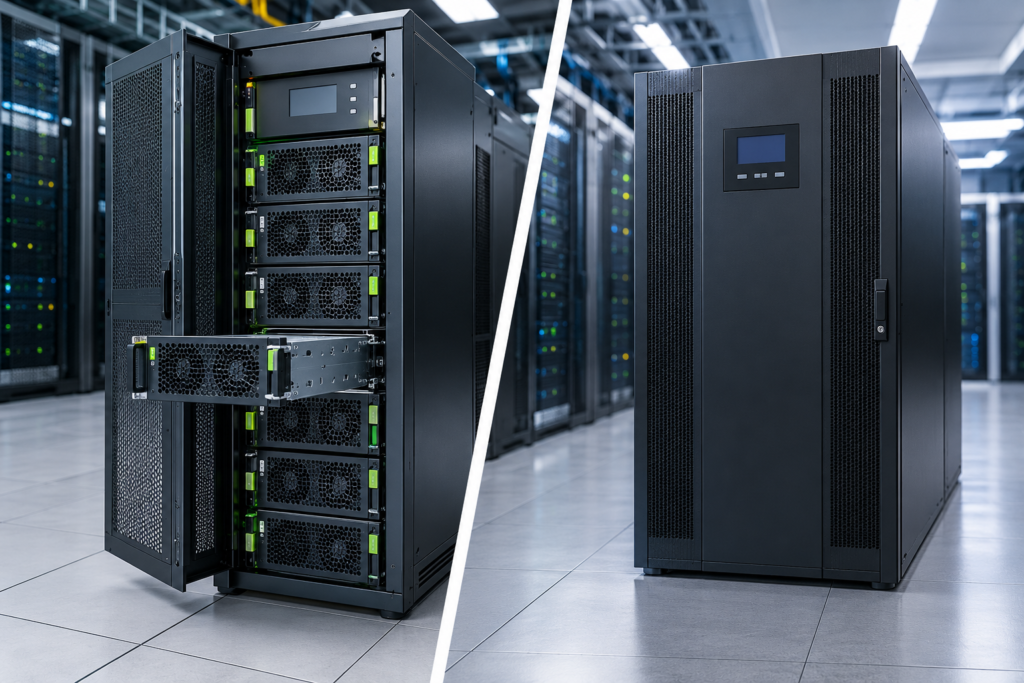
The main difference is that a modular UPS uses interchangeable power modules, while a traditional UPS typically operates as a single, fixed-capacity unit.
A modular UPS system allows businesses to increase power capacity by adding modules to an existing chassis. This flexible approach makes it particularly suitable for organisations expecting future growth or changing power requirements.
Traditional UPS systems, often called monolithic UPS systems, generally have a fixed power capacity. Although multiple units can sometimes be connected for additional capacity or redundancy, expanding an individual system is usually less straightforward.
Both options provide essential backup power, but their suitability depends on your operational requirements.
Key Benefits of Modular UPS Systems
Modular UPS systems offer several advantages for organisations requiring flexible, reliable power protection.
Scalability for Growing Businesses
One of the biggest benefits of modular UPS technology is scalability.
Rather than purchasing more UPS capacity than necessary, businesses can install sufficient capacity for their current requirements and expand as demand increases.
This makes scalable UPS solutions particularly valuable for expanding data centres, growing IT networks and organisations introducing additional equipment.
Improved Energy Efficiency
Modern modular UPS systems can deliver excellent energy efficiency by allowing businesses to match installed capacity more closely to their electrical load.
Avoiding unnecessary oversizing can reduce wasted energy and associated cooling requirements, potentially lowering operating costs.
However, actual efficiency depends on the UPS model, operating mode and load conditions.
Flexible Maintenance and Repairs
Many modular systems feature hot-swappable UPS modules, allowing individual components to be replaced without shutting down the entire system, provided sufficient capacity remains available.
This can simplify UPS maintenance, reduce repair times and minimise disruption to business operations.
How Do Modular and Traditional UPS Costs Compare?
The initial purchase price is an important consideration, but businesses should also evaluate the total cost of ownership.
Traditional UPS systems may offer a lower upfront cost for applications with stable, predictable power requirements. Their fixed-capacity design can make them a practical option when future expansion is unlikely.
A modular UPS may involve higher initial investment, depending on the configuration. However, businesses can often spread expansion costs over time by adding modules when required.
Modular systems may also provide long-term savings through improved energy efficiency, easier maintenance and reduced disruption during repairs.
The most cost-effective option ultimately depends on system size, future growth, installation requirements and ongoing maintenance expenses.
Reliability, Redundancy and Maintenance
For businesses operating critical infrastructure, UPS reliability is particularly important.
Modular UPS systems can incorporate N+1 redundancy, where an additional power module provides reserve capacity if another module fails.
This configuration improves fault tolerance and helps maintain a continuous power supply during certain component failures.
Traditional UPS systems can also provide redundancy through parallel configurations, although these may require additional complete UPS units and associated infrastructure.
Regardless of the design, regular UPS servicing, battery testing and preventative maintenance remain essential.
Even highly resilient backup power systems require appropriate monitoring and professional support to maintain dependable performance.
Which UPS System Is Right for Your Business?
A modular UPS is often the better choice for businesses which are expecting growth or requiring more flexibility and straightforward maintenance. A traditional UPS may be more suitable where power requirements are stable and initial costs are a priority.
Before making a decision, consider several important factors:
- Current power requirements: Determine how much capacity your equipment needs.
- Future expansion: Consider whether additional IT equipment or infrastructure will increase demand.
- Downtime tolerance: Assess the importance of redundancy and uninterrupted operations.
- Available budget: Compare upfront costs with expected long-term expenses.
- Maintenance requirements: Evaluate how easily components can be serviced or replaced.
A professional assessment can help identify the most suitable UPS power protection strategy for your organisation.
Find the Right Modular UPS Solution with Source UPS
At Source UPS, we help businesses protect their critical equipment with reliable, efficient uninterruptible power supply solutions.
We offer a comprehensive range of modular UPS systems from leading manufacturers, including APC, Riello, Vertiv and Eaton, providing scalable power protection for demanding environments.
Our experienced team can assess your requirements, recommend suitable equipment and support your business throughout the installation process.
We also provide ongoing UPS maintenance, battery testing and technical support to help keep your system operating reliably.
Whether you’re upgrading an existing UPS or planning new infrastructure, we’re here to help you make an informed decision.
Explore our modular UPS solutions or contact Source UPS today to discuss your backup power requirements.