Choosing the Right Cooling Strategy When Designing a Data Centre
Choosing the right cooling strategy is a critical part of data centre design. As more processing power is installed into smaller spaces, the heat loads rise and cooling systems have to work harder to maintain safe, stable operating conditions.
The right solution depends on the size of the room, the density of the equipment, the layout of the rack and how the infrastructure is expected to grow. A small server room may only require a wall-mounted air conditioning unit, while a larger or higher-density data centre may need perimeter cooling, InRow cooling and thermal containment.
At Source UPS, we design and supply flexible, high-efficiency data centre cooling solutions for a wide range of applications. Our aim is to help IT equipment perform reliably while achieving high levels of energy efficiency and a low total cost of ownership. We also offer first-class maintenance to keep everything running smoothly.
What is the best cooling system for a data centre?
There is no single cooling system that is suitable for every data centre. The best option depends on several practical factors, including:
- the size and layout of the room
- current and planned rack density
- the heat output of the IT equipment
- available floor and wall space
- redundancy requirements
- energy efficiency targets
- future expansion plans
The design should also account for how hot and cold air will move through the room. Simply installing more cooling capacity will not solve poor airflow management. The system needs to deliver cool air where it is required and remove hot exhaust air before it mixes with the incoming air supply.
Cooling for small rooms
For a small server room, a standalone, portable or wall-mounted air conditioning unit may provide a practical and cost-effective solution.
These systems can often be installed with minimal disruption and positioned to provide cooling close to the IT equipment. They may be suitable for small offices, communications rooms and low-density server environments where heat loads are relatively modest.
However, standard comfort cooling should not be selected without assessing whether it can operate continuously and maintain the conditions required by sensitive IT equipment. Server rooms can produce heat around the clock, even when the surrounding office is unoccupied.
Perimeter cooling
Perimeter cooling, sometimes called in-room cooling, is commonly used in larger server rooms and traditional data centres.
Computer Room Air Conditioning units, or CRAC units, are positioned around the perimeter of the room. In raised-floor environments, the units can push cold air into the floor void, where it is distributed beneath the data centre and released through perforated tiles in the cold aisles.
This approach can provide effective room-level cooling when the rack layout and airflow paths are carefully designed. It is particularly well suited to environments with relatively consistent heat loads.
The position of the perforated tiles, the available underfloor space and the separation of hot and cold air all have a significant effect on performance.
Close-coupled and InRow cooling
As rack densities increase, moving the cooling closer to the heat load can improve both predictability and efficiency.
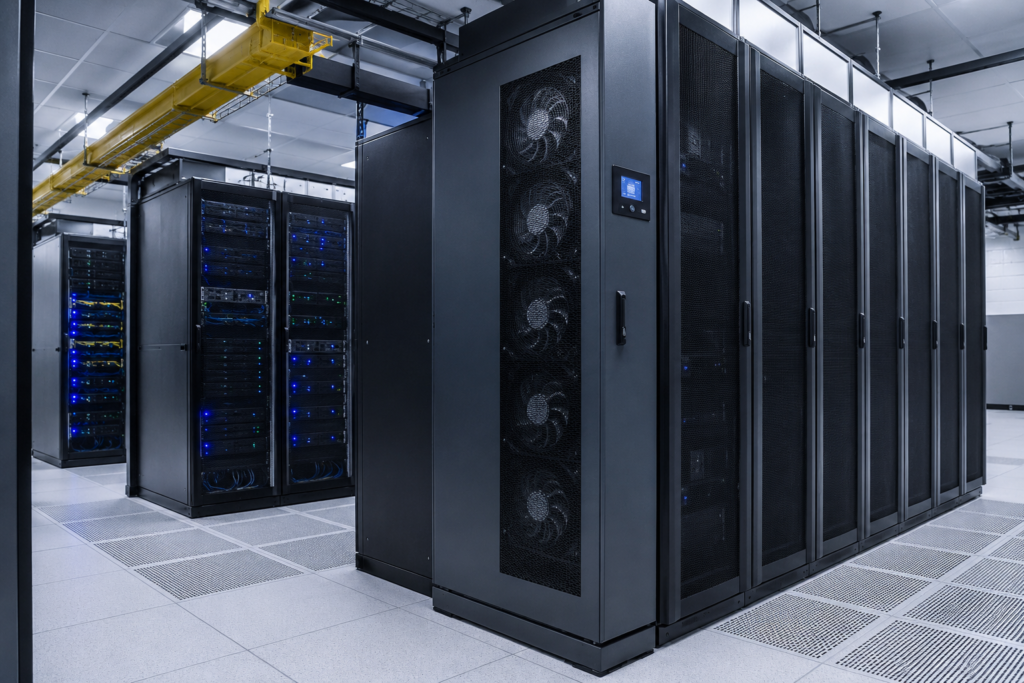
Close-coupled or InRow cooling places cooling units within the row of server racks rather than around the perimeter of the room. Cold air is delivered close to the equipment intake, while hot exhaust air can be captured more directly.
This reduces the distance that air has to travel and helps minimise the mixing of hot and cold air. It can also make the cooling architecture more predictable in high-density environments where traditional room-based systems may struggle to deliver enough cooling to individual racks.
InRow cooling is often used as part of a scalable data centre design because additional units can be introduced as the IT load grows.
How does thermal containment improve cooling efficiency?
Thermal containment separates hot exhaust air from the cold air supplied to the front of the racks.
Without containment, hot and cold air can mix within the room. This makes temperatures less predictable and forces cooling systems to work harder.
Cold aisle containment encloses the cold air supply around the equipment intake and can be used with perimeter cooling systems. Hot aisle containment captures the hot exhaust air and is often paired with InRow cooling.
Both approaches can improve cooling capacity, airflow predictability and energy efficiency. The right option will depend on the rack configuration, cooling system and room layout.
Planning for future capacity
One of the most common mistakes in data centre design is sizing the cooling system only for the current IT load.
Additional servers, storage equipment and higher-density racks can significantly increase heat output. If the original design has no spare capacity, future expansion may require costly changes to the cooling infrastructure.
At Source UPS, we consider both present requirements and likely future demand. We can design cooling solutions that are flexible, scalable and easier to manage as the data centre evolves.
How can Source UPS help?
We provide data centre cooling solutions for small server rooms, larger data centres and high-density IT environments.
Our team can assess the room, equipment heat load, rack layout and airflow requirements before recommending an appropriate solution. Depending on the application, this may include small room air conditioning, CRAC-based perimeter cooling, close-coupled InRow cooling or hot and cold aisle containment.
Because we are independent, our advice is not limited to one manufacturer. We work with leading infrastructure brands and design solutions around the needs of each customer.
Cooling is only one part of a resilient data centre. We can also provide UPS systems, backup power, server racks, power distribution and environmental monitoring as part of a complete turnkey infrastructure solution.
By considering power, mcooling and rack infrastructure together, we help organisations improve reliability, manage energy use and reduce the risk of downtime.