Does My Data Centre Need a Three Phase UPS?
For smaller server rooms, a single phase UPS may still be suitable. However, as power demands and the need for more resilience increases, a three phase UPS usually provides a more efficient, scalable and practical form of protection.
A data centre is likely to need a three phase UPS when it supports:
- high electrical loads
- multiple racks
- critical applications
- equipment that cannot tolerate even a brief interruption to power.
At Source UPS, we design, supply, install and maintain UPS solutions for server rooms, edge facilities, environments for colocation and larger data centres. We are independent, so our recommendations are based on the specific load, risks and operational needs of each site rather than a preference for one manufacturer.
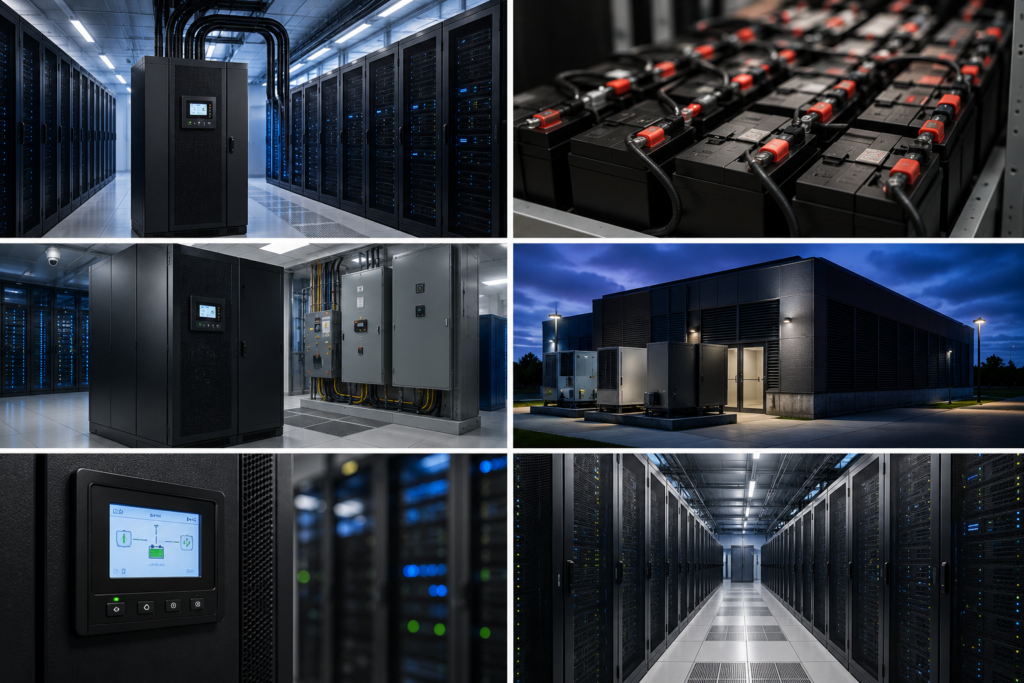
When does a data centre outgrow single phase UPS protection?
There is no single rack count or power figure that automatically makes three phase UPS essential. The decision depends on the electrical infrastructure, total critical load and how the facility is expected to grow.
A small server room with one or two lightly loaded racks may be adequately protected by a single phase system. A data centre supporting dense computing equipment, storage arrays, networking infrastructure and cooling controls will often require a three phase uninterruptible power supply.
Common signs that single phase protection may no longer be suitable include:
- The UPS load is approaching its rated capacity
- Several separate UPS units are being used to support one critical environment
- New racks or higher-density servers are being added
- The site requires improved redundancy
- Battery runtime is becoming difficult to manage
- The electrical supply is already three phase
- Energy efficiency and physical footprint are increasing concerns
Using several smaller UPS units is not always wrong, but it can make monitoring, servicing and capacity planning more complicated.
Is three phase UPS only for large data centres?
No. Three phase UPS systems are increasingly used in edge data centres, modular facilities and compact high-density server rooms.
The physical size of the room matters less than the amount of critical power being protected. A small edge facility can have a high rack power density and strict uptime requirements, making a compact modular UPS more appropriate than several independent single phase units.
Three phase technology can also support future expansion without requiring the entire power protection strategy to be redesigned. This is particularly useful where IT demand is expected to grow or where additional racks may be installed later.
How much critical load does the UPS need to support?
The UPS does not always need to support every electrical load in the data centre.
Its primary role is usually to protect critical IT equipment and essential supporting systems long enough for mains power to return, a standby generator to start or an orderly shutdown to take place. Non-essential loads may be excluded to reduce the required UPS capacity and battery autonomy.
Correct UPS sizing should consider:
- Current IT load in kW
- Apparent power in kVA
- Equipment power factor
- Expected load growth
- Temporary peak demand
- Required battery runtime
- Redundancy level
- Generator start-up time
Sizing a three phase UPS purely from the total rating of the connected equipment can lead to an oversized or undersized system. At Source UPS, we assess the actual load profile and operational priorities before recommending a capacity.
What level of redundancy does the data centre require?
A three phase UPS can be configured in several ways, depending on how much resilience the facility needs.
An N configuration provides enough capacity to support the full critical load, but it does not include an additional power module or UPS for redundancy. An N+1 arrangement adds spare capacity so the load can remain protected if one module fails or is taken out of service.
More critical environments may use 2N or other parallel UPS configurations to remove single points of failure and support concurrent maintenance.
The right design depends on the cost and consequences of downtime. A small internal data centre may accept a different level of risk from a colocation facility, financial platform or healthcare environment.
Modular and monolithic UPS architectures
Both modular and monolithic three phase UPS systems can be suitable for data centres.
A monolithic UPS provides its rated capacity through a single main system. This can be a practical option when the power requirement is stable and future expansion is limited.
A modular UPS uses separate power modules that can be added as demand grows. Depending on the design, these modules may also provide built-in N+1 redundancy. This approach can improve scalability, simplify maintenance and reduce the amount of unused capacity installed from the outset.
However, modular is not automatically better for every site. Initial cost, available space, maintenance strategy and expected growth should all influence the decision.
How long should a data centre UPS run?
There is no universal runtime requirement.
Some data centre UPS systems are designed to provide only enough battery backup time for a generator to start and stabilise. Others require longer autonomy because a generator is not available or because the organisation needs more time to shut systems down safely.
Runtime depends on the UPS load and battery configuration. External battery cabinets, VRLA batteries or lithium-ion battery systems may be used where longer autonomy, lower maintenance or reduced footprint is required.
Battery condition also matters. Even a correctly sized three phase UPS will provide insufficient runtime if its batteries are old, poorly maintained or exposed to high temperatures.
What else should be considered before installation?
Installing the UPS at a data centre involves more than choosing a power rating.
The design may need to account for switchgear, arrangements for maintenance, routes for cables, ventilation, floor loading, monitoring, battery location and generator compatibility. The UPS should also be positioned so it can be serviced without creating unnecessary risk to the critical load.
A detailed site survey helps identify these requirements before equipment is ordered. It can also reveal issues such as limited electrical capacity, restricted access or insufficient cooling.
How Source UPS can help
At Source UPS, we provide complete data centre power protection solutions, from initial site assessment and system design through to delivery, installation, commissioning and ongoing maintenance.
Our team has experience with leading manufacturers including APC by Schneider Electric, Riello, Eaton and Vertiv. As an independent specialist, we compare the available options and recommend the system that best suits the application, budget and resilience requirements.
We can also help with UPS replacement projects, battery systems, maintenance bypasses, monitoring and planned upgrades.
A three phase UPS is not necessary for every data centre, but it is often the right choice where loads are high, expansion is expected or downtime would have serious consequences. The key is to base the decision on the critical load, runtime requirement, resilience target and long-term growth of the facility.