What Size APC UPS by Schneider Electric Does Your Business Need?
Choosing the right size UPS by Schneider Electric depends on your equipment load, required runtime, environment and plans for future growth. In simple terms, your UPS must be large enough to support your critical equipment safely, but not so oversized that you pay for capacity you do not need.
At Source UPS, we help businesses choose, install and maintain the right uninterruptible power supply for their needs. As an independent IT infrastructure and power protection specialist, we look at the full picture before recommending an APC UPS by Schneider Electric, from server room requirements and data centre capacity to battery runtime, resilience and ongoing maintenance.
Why Does the Size of a UPS Matter?
UPS size matters because an undersized system may not protect your equipment properly, while an oversized system can increase unnecessary costs.
A UPS is designed to provide backup power when the mains supply fails or becomes unstable. It also helps protect sensitive IT equipment from power disturbances, voltage fluctuations and unexpected shutdowns. If the UPS is too small for the load, it may become overloaded, reduce runtime or fail to support your systems when you need it most.
The right APC UPS by Schneider Electric should support your critical equipment, provide enough backup time and fit your operational needs. Schneider Electric also provides UPS selector tools to help match UPS systems to different environments, including small business, server room and network closet applications.
What Does Capacity Mean in Relation to UPS?
UPS capacity is usually measured in VA, kVA, watts or kilowatts. These figures help determine how much electrical load the UPS can support.
For smaller IT setups, you may see APC UPS systems measured in VA, such as 1000VA, 1500VA or 3000VA. For larger environments, UPS systems are commonly measured in kVA or kW. For example, a business with a small communications cabinet will usually need a very different UPS size from a company operating a full server room or data centre.
APC Smart-UPS systems are designed for network power protection and are commonly used for servers, point-of-sale equipment, routers, switches and other network devices. For larger power requirements, Schneider Electric also offers a wider range of three phase UPS systems for data centres, mission-critical systems, enterprise networks and industrial applications.
How Do You Calculate the Size of UPS You Need?
To calculate the size of UPS your business needs, start by listing every piece of equipment that must stay protected when there’s a power issue.
This may include servers, switches, storage devices, routers, telecoms equipment, CCTV systems, access control equipment, firewalls, computers or other business-critical devices. You then need to understand the total load of that equipment and allow suitable headroom.
As a general rule, you should avoid running a UPS at its absolute maximum capacity. Allowing headroom helps improve reliability, supports future expansion and reduces the risk of overloading the UPS. At Source UPS, we always assess both current and future requirements before recommending a UPS system.
How Much Runtime Does Your Business Need?
Runtime is the amount of time your UPS can keep equipment running during a mains power failure.
Some businesses only need a short runtime to allow equipment to shut down safely. Others need longer backup power to keep systems operating until mains power returns or a generator takes over. This is why two businesses with the same electrical load may still need different UPS solutions.
Battery configuration has a major impact on runtime. Depending on the APC UPS by Schneider Electric selected, you may be able to add external battery packs or specify a larger system to achieve the required backup time. Runtime should always be matched to your business continuity plan, rather than guessed.
Do You Need a Single Phase or Three Phase UPS?
A single phase UPS is commonly used for smaller IT environments, comms rooms, network cabinets and office-based equipment. Many APC Smart-UPS and APC Easy UPS systems are suitable for this type of application.
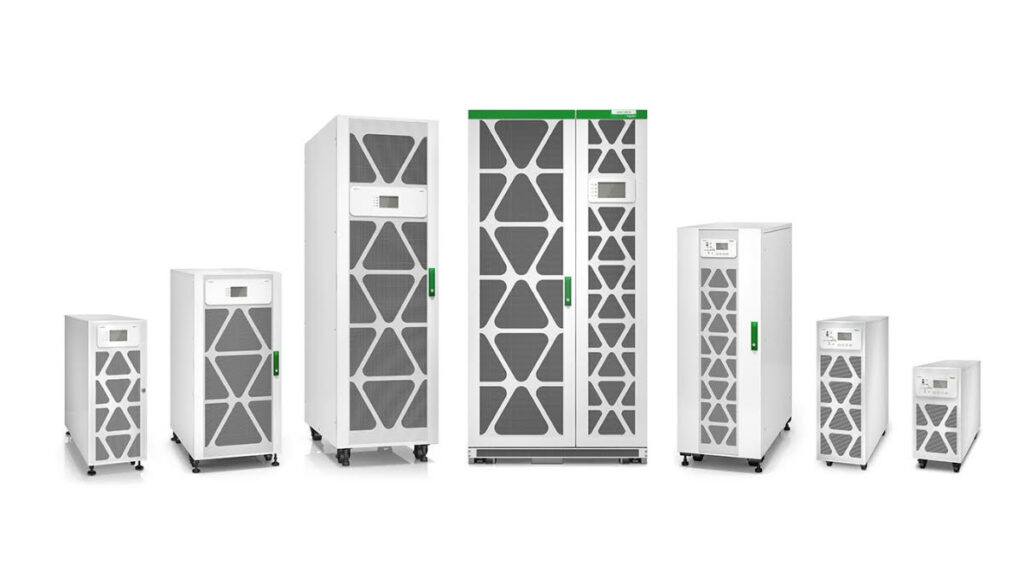
A three phase UPS is usually required for larger server rooms, data centres, commercial buildings and higher-load environments. Schneider Electric’s Easy UPS range includes three phase systems designed for small, medium and large businesses, commercial buildings, light industrial sites and other mission-critical applications. The Easy UPS 3S range, for example, is designed as a 10–40kVA three phase UPS for small and medium data centres and other business-critical applications.
If you are unsure which type your site needs, we can help assess your electrical supply, load profile and infrastructure requirements.
Sizing an APC UPS for a Server Room
For a server room, UPS sizing should consider more than the servers alone.
You may also need to protect switches, storage, firewalls, monitoring equipment and supporting network hardware. The UPS should also be installed in a suitable environment, with appropriate ventilation, access for maintenance and consideration for battery health.
At Source UPS, we regularly support businesses with server room UPS solutions, rack infrastructure, cooling, power distribution and monitoring. This allows us to recommend a solution that fits into the wider IT infrastructure rather than treating the UPS as a standalone box.
Sizing an APC UPS for a Data Centre
Data centre UPS sizing is more complex because the consequences of downtime are usually greater.
A data centre UPS may need to support multiple racks, larger electrical loads, redundancy, planned maintenance access, monitoring and future expansion. In these environments, it is important to consider resilience as well as capacity. The right solution may include a three phase UPS, external batteries, bypass arrangements and ongoing preventative maintenance.
As an APC by Schneider Electric Elite Data Centre Partner and Services Reseller, we have the experience to help design reliable UPS and infrastructure solutions for demanding environments. Our team can advise on APC UPS systems, Schneider Electric power protection, cooling, rack solutions and monitoring products.
Why Work with Source UPS?
Choosing the wrong UPS size can create avoidable risks, including limited runtime, overloaded equipment, unnecessary costs and reduced resilience.
At Source UPS, we take an independent approach. We listen to what your business needs, assess the available options and design a UPS solution that supports reliability, efficiency and business continuity.
Whether you need backup power for a small network cabinet, a server room or a larger data centre, we can help you choose the right APC UPS by Schneider Electric.
For more information for our solutions from APC by Schneider ELectric, simply get in touch today.