Small UPS vs Enterprise UPS Power Supplies: What’s the Difference?
UPS power supplies are often treated as a simple tick-box purchase. Many organisations choose something based on price, then swiftly move on. In reality, there is a significant difference between small UPS systems and enterprise-grade UPS power supplies. And choosing the wrong one can lead to downtime, wasted money or limited future growth.
Understanding where the line sits between small and enterprise UPS solutions helps ensure your power protection actually matches your business needs.
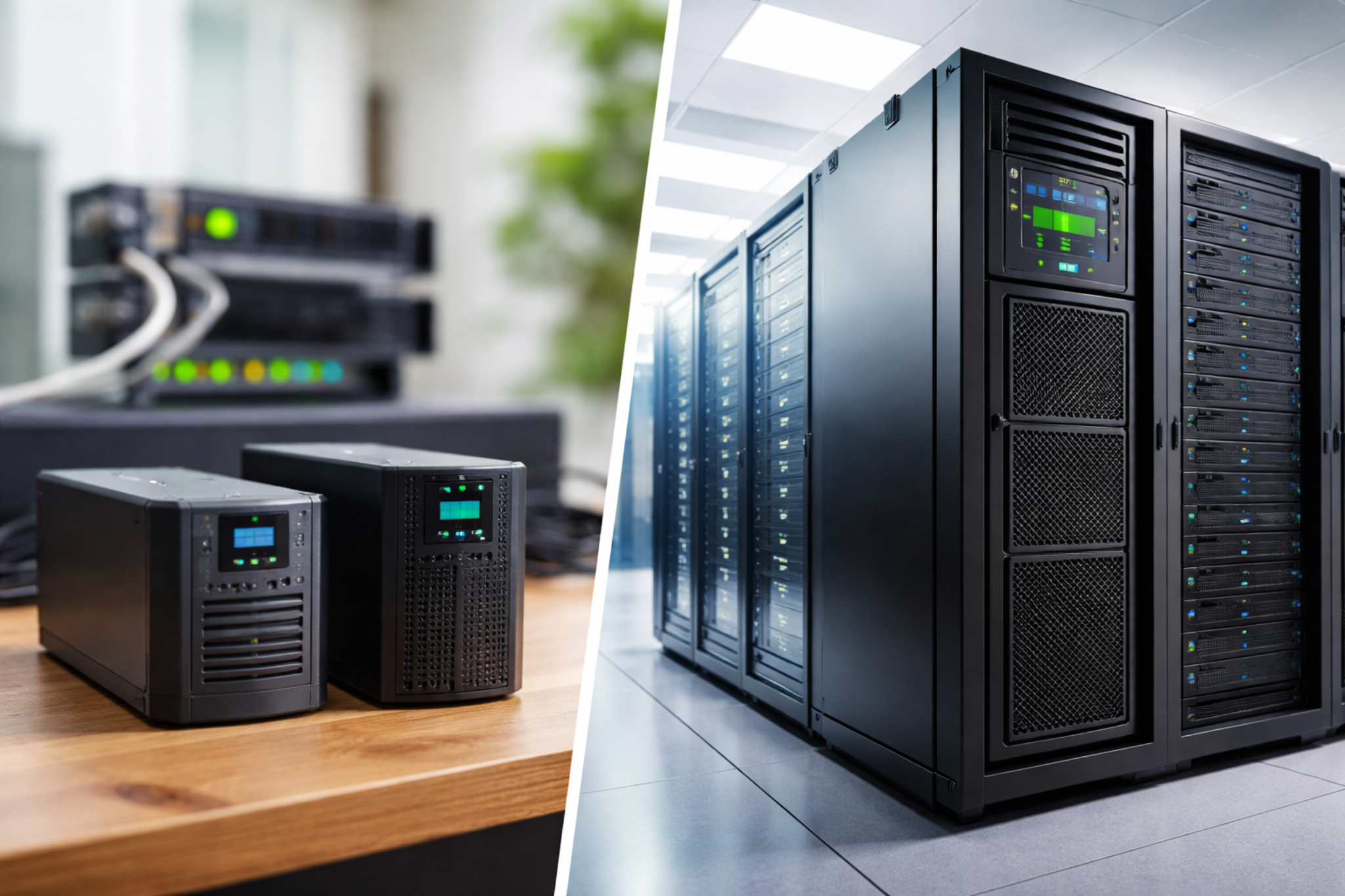
What Is Considered a Small UPS Power Supply?
A small UPS power supply is typically designed to protect individual devices or small groups of equipment. These systems are commonly used in home offices, retail environments and small business IT setups.
Typical applications include:
- Desktop PCs and monitors
- Network switches and routers
- Small servers or NAS devices
- EPOS systems
- CCTV and access control equipment
Small UPS power supplies are usually compact, self-contained units that plug directly into a standard wall socket. They often provide short runtime, usually a few minutes, which is enough to ride through brief power interruptions or allow a safe shutdown.
They are attractive because they are:
- Low cost
- Easy to install
- Readily available
- Simple to operate
For many basic applications, a small UPS does exactly what it is supposed to do. Problems arise when these systems are expected to protect more critical or growing infrastructure.
Limitations of Small UPS Systems
While small UPS power supplies have their place, they come with limitations that are often overlooked.
First, capacity is fixed. Once you exceed the load the UPS was designed for, there is no room to expand. Adding extra servers, switches, or storage can quickly push the system beyond its limits.
Second, redundancy is usually non-existent. A single UPS represents a single point of failure. If the unit develops a fault or a battery fails, there is no backup.
Third, runtime is limited. Many small UPS systems only provide enough battery power for a controlled shutdown, not continued operation.
Finally, management and monitoring options are basic or unavailable. In larger environments, not knowing the health of your UPS power supplies can be a serious risk.
What Defines an Enterprise UPS Power Supply?
Enterprise UPS power supplies are designed for mission-critical environments where uptime, scalability, and resilience are essential. These systems are commonly used in:
- Server rooms
- Data centres
- Healthcare environments
- Airports and transport infrastructure
- Manufacturing and industrial facilities
Enterprise UPS systems are typically rack-mounted, modular, or standalone large-format units. They support higher power loads and are designed to integrate with wider IT and facilities infrastructure.
Key characteristics include:
- High power capacity
- Scalable or modular design
- Redundant components
- Extended battery runtime
- Advanced monitoring and management
Unlike small UPS units, enterprise UPS power supplies are part of a broader power protection strategy rather than a standalone device.
Planning for Growth
One of the biggest differences between small and enterprise UPS power supplies is scalability.
A small UPS is usually sized for today’s requirements only. If your business grows or your infrastructure changes, the UPS often needs replacing entirely.
Enterprise UPS systems, by contrast, are designed to grow with your organisation. Modular UPS designs allow capacity to be increased as demand rises, without replacing the entire system. Battery runtime can also be extended by adding battery modules rather than changing the UPS itself.
This approach is more cost-effective long term and avoids disruption as your IT environment evolves.
Redundancy and Resilience
In critical environments, redundancy is not optional. Enterprise UPS power supplies support configurations such as N+1 or 2N redundancy, ensuring that a single failure does not result in downtime.
Small UPS systems rarely offer this level of protection. If the unit fails, protected equipment is exposed immediately.
For organisations where downtime affects revenue, safety, or reputation, enterprise UPS systems provide a level of resilience that small units simply cannot match.
Power Quality and Protection
Both small and enterprise UPS power supplies protect against power cuts, but enterprise systems go further in managing power quality.
They offer superior protection against:
- Voltage sags and spikes
- Brownouts
- Harmonic distortion
- Frequency variations
In modern IT environments, poor power quality can be just as damaging as a total outage. Enterprise UPS systems condition incoming power continuously, helping to extend the life of sensitive equipment and reduce unexplained failures.
Monitoring, Management and Maintenance
Another key difference lies in how easy they are to control.
Enterprise UPS power supplies integrate with network monitoring tools and building management systems. They provide real-time data on load, battery health, runtime, and alarms.
Small UPS systems often rely on local alerts or basic software, which may not be suitable for unattended or remote environments.
Maintenance is also more structured with enterprise systems, with service plans, battery replacement schedules, and remote diagnostics forming part of the solution.
Which UPS Power Supply Is Right for You?
The choice between small and enterprise UPS power supplies depends on several factors:
- How critical your systems are
- Whether downtime is acceptable
- Future plans
- Required runtime
- Budget versus long-term cost
This is where independent expertise becomes valuable.
How Source UPS Helps You Choose Correctly
Source UPS works with organisations of all sizes, from small office environments to full-scale data centres. As an independent IT infrastructure specialist, Source UPS is not tied to a single manufacturer and provides unbiased advice based on real-world requirements.
Whether you need a small UPS to protect a single server or an enterprise-grade UPS power supply designed for scalability and resilience, Source UPS designs, supplies, installs, and maintains solutions that fit your environment.
If you need help choosing the right UPS power supplies, simply contact our team for more information.
We have 9 UK data centres and Source UPS are our preferred supplier for infrastructure. Their advice is always valuable and well considered. I would strongly recommend Source UPS.